Welcome

Welcome All! I'm a dreamer, I hope you are too! A Posse ad Esse, or From possibility to reality, is a general state of mind. I hope you'll share your possibilities with me as I will with you. Namaste~

June 16, 2010

Cruising the West (Day 1)

The weekend before last, the family and I hit the highway for what amounted to a miniature version of a great American road trip. We left our home in Northern UT early Friday morning and headed South to parts yet un-seen. Day one found us driving through the Southern UT red rock and Arches country and we made the best of it.

As it turns out, by luck or dicine intervention, we happened to land smack dab in the middle of the very hard to hit 3 week desert bloom season. What followed was an amazing sight of beautiful rock formations, scenic landscapes and surprising floral beauty. For anyone resigned to thinking that deserts are barren, lifeless, moonscapes... I offer the following. Enjoy!
A little reminder... The desert is ALIVE!
Balancing rock... obviously!?

This view is of a place called "Garden of Eden".
Can you believe this flower? I didn't even know this shrub bloomed!
A place called the "Windows". We hiked up with our lunches...
and this was the view from our "table".

If this old tree could tell stories???

I loved this flower! I could hardly believe something so delicate was out there.
Utah's famous "Delicate Arch"

The hills were almost glowing with the green haze of grasses. A sight seldom seen in this arid landscape!

Aren't these beautiful? They were all over the roadside.
This was one of our final views before leaving the park.

It was truely a magical day of adventuring and getting to enjoy each others company.
After leaving Arches, we continued South through Moab and toward Cortez CO, on the way I found this tourist stop. I've tried to remember where it was at for many many years. I went here as a child and have always remembered it. It's a home that a man carved, by hand mind you, into the side of the native sandstone cliff. It was once he and his wifes home where they ran a small diner. Today it's a little tourist stop with a tour through the home. I HAD to take the boys through it. Hopefully they'll remember it as much as I did!

And of course, how could I not get a picture of this??

Hope you enjoyed the photo tour. Day 2 will find us in Mesa Verde CO. Home of the Ancestral Pueblo Cliff dwellers. Very very cool. You'll like it I promise!

Till next time.
P~

June 3, 2010

Catching up after a long long spring

This Spring has been a bear!
Last years spring was wet. I thought it odd, but hey, it's spring in Utah. That stuff happens. This Spring however makes last years look timid.

Looking at the local weather station stats I found that the temperature was below average for 26 of the 31 days in May by an average of over 7 degrees lower. Eleven days were lower by 10 or more degrees and a few of those were nearly or even at 20 degrees below normal!!

It was wet too. having rained or snowed on 14 of the days. Nearly half the month. Now, this is the normal time of year for us to get a good bit of wetness, so that's not a big deal. The odd part is the number of rain storms this year that have hammered the crap out of everthing. The wind gusts have been far higher and nearly every storm of any kind, results in hail. That is not cool for leafy veggies!

The cool wet spring has been good for peas though. The annual favorite of the wet spring weather has not yet let us down. We planted three beds of peas this year and all are doing fairly well. Here's one of them all tied up to the "square in the air" that I like to use. And here's another in one of the few beds that doesn't yet have a trellis set up. No worries though, a few bamboo stakes a little creativity and the peas have been supported.
And here's another big surprise of the season. I never would have guessed when I over-wintered theses babies in the greenhouse that they were so cold tollerant. My first harvest of the year has been an artichoke!
And there's another on the way...
Last weekend was one of the first weekends that we've had in some time that were worth getting out and getting much done. I took advantage of that weather to get some of the plants from the G-house out and transplanted.
Here's the Meyer Lemon tree all pruned up and re-potted. Looks good eh?
And here's an experiment for this year. Potted Tomatoes. In these pots I planted the three cloned Heartland tomatoes from last year, Two Rutgers Tomatoes and a San Marzano.

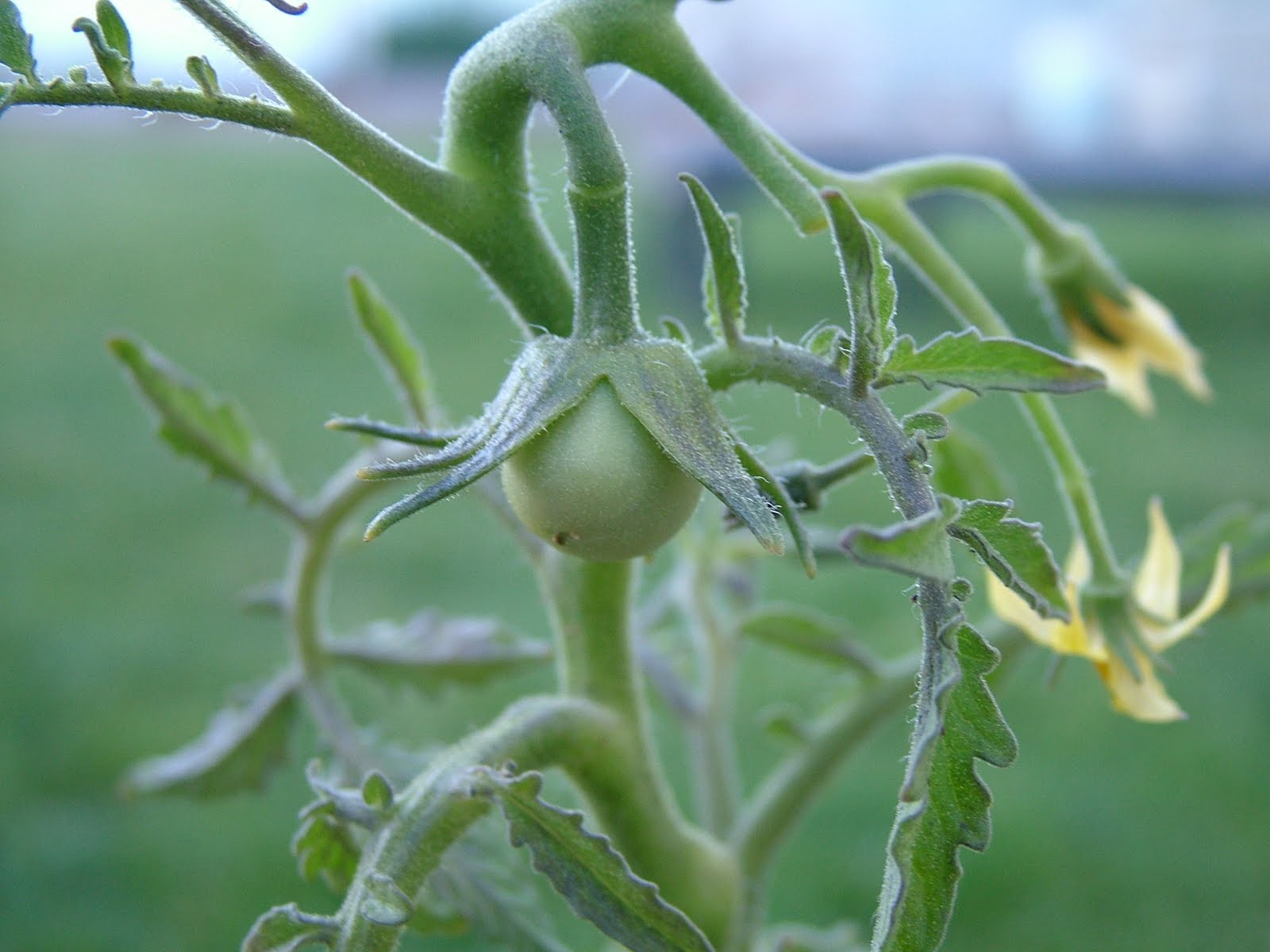
And speaking of the cloned Heartland tomatoes... how about this.
They're fruiting!

One...

Two...

And yes, all three cloned tomatoes are fruiting!
The plants are a bit stunted looking, but I think they'll come along. The point is. These plants are fruiting and that means they are a success in my book!

This year I'll make it a point to also save some seed from them, but at least I'll have the opportunity.

Today I'll leave you with a picture of the summer iteration of the greenhouse. Shade cloth included.
The weather man says it's supposed to get into the 80's this week, so some adaptation was in order. We'll see how this does for me.
Hopefully the bad weather's behind us for now and we can move on into the growing season. This weekend I'll be getting beans started so it better!
P~

June 1, 2010

A little community work

I've mentioned in passing, here and there, little tid bits about community gardens. I've wanted to get my hands into a community garden in my area for sometime. This spring, I thought I was going to get that opportunity.

A nearby city, wanted to start a community garden. A co-worker of mine brought in a newspaper with an article that he had read that said they were looking for a coordinator to help provide them some vision and to bring the project to fruition as it were. A~ and I went to the first meeting that they had, as interested parties. There was one other person that showed any interest in helping and he was there as well.

As it turned out, he and I were about as far apart on the community garden front as two people could possibly be. I, to put it plainly, believe community gardens should be organic poly-cultures made up of plots that are "owned" by individual gardeners or families. I think they offer a great opportunity to learn from each other and to offer instruction to the community. The other fellow is more of a "traditionalist" shall we say. He likes to have big rows of one crop. He's big on chemical fertilizers, even to the extent of telling me that he's "planted a little late when it's been cold weather and then just really go heavy on the fertilizer for a few weeks to catch them up." and when we discussed classes for beginning gardeners his belief was that we'll tell them when they have to spray for this bug or that. Yeah, like I said, we're really diametrically opposed on the basics.

Long story short, and believe me it was a long story, I ended up not doing the community garden at all. Not so much because I'm not willing to work with others well or anything. Basically I guess I was just not willing to put the things I believe in so strongly to the side for the sake of working with what was a very very... ummm... Strong personality. Yes, that's it, a strong personality.

If I'm being honest about the whole process, I don't blame that guy at all. He was reliable, he was motivated and he was a hard worker from what I saw. He and I were just from two different schools of thought. The problem I have with the whole process was with the city and it's representatives through the whole process. From the get go, I realized that we envisioned two distinctly different visions for the garden and I put my vision together on a very clearly stated "mission statement" for lack of a better description. I sent this to the administrators and said basically "This is where I'd like to take you, if you want to go there, I'm your guy. If you don't them he's your guy. No hard feelings either way." Still, the city had no commitment to a particular vision of their own, and from what I can tell were just bulldozed into doing whatever was in front of them by a "very strong personality".

In the end, I did end up going down and helping the five families that ended up having small plots in the garden to get a few things planted. I donated some tomato plants that I had started and I felt good helping out to some degree. It was a learning process and one that pointed out a number of things to be concerned with the next time I take on a venture like this again in the future. And I will take one on again I'm sure!

Here are a few picture of the garden as is stood on the 22nd of May when we went out to plant. It had rained hard for two days prior to planting so it was a bit of a mess, but we did get get planted nonetheless.This is the whole garden. It's a really good sized area that the city decided to use. You can see some of the plots along the back and right side that have been planted already. Corn, Tomatoes, peppers and tomatillos. That's it. All planted by one guy, paid for by the city. It will go to the local food bank so that's good. But apparently the local families will have only corn and salsa?
This section. has a number of smaller plots laid out and are the plots allotted for individual families. The plots on the right side were complete soup. Very very wet!

And here were a few of the families that showed up to plant.

I hope I don't come off too whiny about the whole process. It was a great thought that the city had in wanting to have a community garden for it's citizens and I wish them all the very best of luck. I just can't help but see so many possibilities that are being missed.

One day.... Till then, best to you all.
P~

May 18, 2010

Fermentation Friendly Home(stead)

Yes, I think I can safely say that we are a fermentation friendly home(stead).
We've made home-made lacto-fermented sauerkraut, traditional sour brine pickles and pickled corn,
We've grown Lactobacillus cultures to ferment milk into yogurt,
We've brewed our own beer,
We've kept our sourdough starter as a member of the family for nearly the last three years.
Now... well now it's time to welcome "Mother" home.

I'm talking about a Mother SCOBY for kombucha of course. If you're not familiar with what Kombucha is, it's a fermented tea that many claim has many healthful properties. I cannot speak to that yet, but it is a good tea from what I've had of it... good enough to try making some on my own! My kids really seem to enjoy what we've had of it; we've tried a few different varieties from our local health food store.

The first thing we needed to do was to start a SCOBY of our own. SCOBY is an acronym for Symbiotic Colony of Bacteria and Yeast. It contains the different bacteria and yeasts that consume the sugars in in the sweetened tea and create the acids and bubbles that are indicative of good kombucha. There are places, I'm told, where one can purchase a Mother SCOBY, but me being me, I had to try to start on on my own.
This is a bowl of tea that I made from Jasmine Flower Green tea and added about a third of a bottle of RAW kombucha that had a small piece of culture starting in it. This little piece was about the size of a quarter and I hoped it would have enough of the live micro-organisms and yeasts to start a new SCOBY.
I left it, covered with a towel, for about ten days on top of my refrigerator and it bloomed very nicely... for lack of a better definition.

Here you can see the new home that I moved it over to this weekend.
It's a two-gallon FOOD GRADE plastic bucket. I brewed a large batch of the same Jasmine Green Tea and sweetened it with about a cup and a half of sugar. To that I added about a cup of the tea from the small batch that I used to grow my new Start and slid the new SCOBY start into it.
And here's the new SCOBY that I have so far. It's darker than most that I've seen, but it's also just started. My hope is that as the new "daughter" SCOBY grows it will form the typical whitish cellulose SCOBY that I've seen before.

So then, I know some of you have made these before, can you tell me if I'm on the right track? How's it looking so far. With any luck, I think that in the next week and a half or so I should be able to drink it!

Are you a fermentation friendly home(stead)? I'm thinking I need to come up with a neat little side bar banner for that? what do you think?
Well, best to you... till next time.
P~

May 11, 2010

Growing Raspberries

I teach quite a few classes every year as a Master Gardener through our local extension service. Every time I teach one of the classes it seems that I get the same questions over and over again.

One of the questions I will get almost invariably, is about raspberries. There's few berries, I think, that are more coveted than fresh sweet raspberries so it doesn't surprise me. That being the case, I thought I'd go over a couple of the basics and take it from there.Here's half of my raspberry patch. I'm standing right where my other half is "supposed" to be growing. Last year it was overtaken by a really bad infestation of field bindweed and needed to be clipped to the ground to let me get a hold of it.

Here are a few basics of raspberries:
1. There are two main types of raspberries, Summer bearing and double or "ever" bearing. The names may sound a lot like the names given to the different strawberry type, but they aren't really the same. I'll get to the reason why in just a minute but suffice it to say that with summer bearing varieties you will get one crop per year from them and with ever bearing you will get two.

2. Raspberry plants are made up of two different types of canes. Primocanes and Floricanes. The primocanes are the fast growing soft skinned canes that grow up to 4- 6 feet tall in one year. You can see one below... You can see the very green tissue of the plant and the healthy flush of new growth coming up from the center of the plant. This is a new cane and it will grow very quickly throughout the summer. At the end of summer this cane should NOT be pruned out. Raspberries, at least the traditional summer bearing ones, will form on these canes the next summer. At that time, when the dry and dormant canes begin to grow, the canes are known as floricanes. These floricanes will fruit heavily in the summer and then will be finished. At this point, the canes can be pruned out.
EXCEPTION to the rule is made for double or ever-bearing varieties. For these varieties the same thing applies to the primocanes growing rapidly throughout the summer months. They will look the same but towards the end of the first year they will grow fruit. The harvest from this fruiting won't be as big as the summer harvests, but it's kind of a bonus one. The next year, as a floricane, it will bear fruit in the summer. Again, this is the last harvest for this cane and it can be pruned out to leave room for new primocanes to grow for next year.

Here's a picture of one of my patches floricanes from this year...Like I was saying, it looks like a dead dry stick. It will be tempting to prune these out at the end of the previous year, or to do so in the early spring but hold off.

As I was saying, after the floricanes have fruited in the summer of their second year, they are expired. They don't fruit anymore after that. At least not enough to warrant keeping them. My hardest thing to keep track of at the end of the summer when I get around to pruning them is which canes to thin out. That explains my little red yard pieces.I decided that this year I was going to mark the canes that are already growing and that I expect to harvest from this year. After the harvest is complete and I have time to prune, I will just go along the bottoms of the canes and thin out all of them that have red yarn on them.
Now, mind you, this isn't a technique that is practical for any sort of larger production. However, it is one of the perks of running a little nano-farm with a small patch. I can do things like this to help manage the patch. I'd like to perhaps find some sort of organic, or plant based paint that I could slap on the bottoms of the canes instead, but for now, this will do the trick.

Hope this clears up a few of the questions that you may have had regarding raspberries. I know it just skims the surface, but that was kind of the point. For more references about raspberries in your area, try checking online to your local extension service.

Best to you all, hope all's growing well!
P~

May 4, 2010

When life gives you lemons...

Well, maybe it's because you have a new Meyer lemon tree??

Alright, I admit it, I'm cheesy. But I did get a new Improved Meyer Lemon Tree last weekend.

I've been wanting one of these for a couple of years now. Then, last year when I got some of my mom's lemons I was sold. They are soooo good! So Saturday afternoon, my gift for my (gulp) thirty ninth birthday, was a lemon tree.
And here she is. My little limoncello machine! right there in her current home in the greenhouse. We've been having some really off again on again cold spells punctuated by hot days so I think I;'ll keep her in there for another couple of weeks to be safe. Later she'll be in a nice pot that I inherited from my uncle and will be kept outdoors for the summer.

And there's lots going on in that thar greenhouse too. As you can see below. I can hardly move around in there any more.There's lots of tomatoes, a lemon tree, peppers, cantaloupes cucumbers, tomatillos, marigolds, herbs...
Even some pumpkin starts that are doing really well.
And I found this on one of the little heartland tomato clones that I was able to hold over the winter. Guess there's no better testament to a healthy plant than that huh?

But Wait! There's more... There's life outside too!
Our onions are coming along well, and just about ready for a good mulching with some straw. I would love to do it earlier in the season, but our winds here just undo all my hard work.
It may be hard to see, but this bed has one of our first carrot plantings of the year growing up in it. There's five rows with a couple of extra wide spaces in the middle section. On either side of the bamboo stakes that are laying there will be planted beans for this year. The carrots will grow right along with them in the shaded area.
Here's a closer look.

And some peas. These are not doing too well. Late winter storms beat them up. Not the cold mind you but the winds. They broke a lot of them off right at ground level.

The first Kohlrabi plantings had trouble too. notice the front (windward) side of both beds were hit the hardest?
This bed has my bok Choi Chinese cabbage and is surrounded by carrots. Later in the season I'll fill the bed in with pumpkins and squash.

Not much to say... more peas!
And last but not least, the potato garden. Lots of green popping up here too!

So there you go, all caught up right? well, kind of... still have a couple more posts that I'll try to get up soon. Too much to do, not enough time!

hope all's growing well with you all
P~